The role of the Probate Commissioner and the procedures for the Probate Court are set forth in Washoe District Court Rule 57 (external link, opens in new tab). These Guidelines are promulgated to provide parties and their counsel with procedures and information to supplement that rule. Carefully following these Guidelines will ensure your matter is adjudicated in the most efficient way possible.
All probate filings must be completed electronically, via the “E-Flex” system. For more information, see the Court’s E-Filing Information page. Please refer to WDCR 10 (external link, opens in new tab) for the proper formatting of all papers filed with the Court.
All petitions, pleadings, or other moving papers must use the “PR” designation for Probate Court as the Department Number in the caption unless otherwise ordered or unless the case has been referred to another judicial department. All newly filed cases will be assigned a new case number. The clerk will not fill in a new case number (or a hearing date) in the caption of your pleading.
All petitions must be verified according to NRS 15.010 (external link, opens in new tab) and must have the appropriate document code for the type of document filed. Please see the document code list.
All filed papers and exhibits must not contain certain personal information of any person (living or deceased). Personal information includes, but is not limited to: Social Security Numbers, Driver License Numbers, and Account Numbers of any kind. See WDCR 10(8) (external link, opens in new tab). The last four digits of any such number may be left unredacted. Every paper filed must, immediately above the last signature line, contain an affirmation as required by WDCR 7 (external link, opens in new tab). A standard affirmation form to use as the last page of your filing can be found on the Probate Forms page. Inclusion of personal information, or failure to include a proper affirmation, will result in the striking of your filing.
Trust matters (governed by Chapters 162 through 167 (external link, opens in new tab) of Nevada Revised Statutes) are heard by the Probate Court in the same manner as probate matters (which are governed by Title 12 (external link, opens in new tab) of Nevada Revised Statutes). Petitions concerning trust matters must expressly state the basis for, and seek, the Court’s assumption of jurisdiction over the trust, see NRS 164.010 (external link, opens in new tab), in addition to seeking relief related to a trust’s internal affairs, see NRS 164.015 (external link, opens in new tab).
The weekly Probate calendar can be found at on the Probate Calendar page. All hearing requests must be submitted through the website. In order for your request to be approved, you must first file the petition or other matter to be heard, and submit a proposed order, in Microsoft Word format, to the Probate Department at probatedept@washoecourts.us.
Once a petition is on file and a proposed order in Word format has been emailed, you can schedule a hearing by following these steps:
When you have a confirmed hearing date, you must file a notice of hearing. The basic form of Notice of Hearing can be found on the Forms section of the Probate Department , but particular language may be required in some special cases, such as appointment under the Independent Administration of Estates Act, NRS 143.345(3) (external link, opens in new tab), approval of attorney fees, NRS 150.060(9) (external link, opens in new tab), or the set aside of an estate without administration, NRS 146.070(11) (external link, opens in new tab).
In accordance with the Administrative Order 2020-7, the following additional language is required to be added to any notice of hearing that is filed in accordance with NRS NRS 155.010 and NRS 155.020:
This hearing will be conducted by conference call only. Any person who wishes to be heard on this matter shall obtain the public dial-in number and Meeting ID by visiting the Probate home page , or by calling (775) 328-3100 at least two days in advance of the hearing.
The Notice of Hearing must be served by mail on all “interested persons” in the estate, and in some cases, published in advance of the hearing date. See NRS 155.010 (external link, opens in new tab) and NRS 155.020 (external link, opens in new tab). The definition of an “interested person” can change during the course of an estate. For more information, see NRS 132.185 (external link, opens in new tab) and NRS 132.390 (external link, opens in new tab). Once the notice is mailed, a Certificate of Service should be filed into the case.
Initial petitions for probate, and for the setting aside of an estate, must be mailed to the Director of the Nevada Department of Health and Human Services, through its Medicaid Estate Recovery Unit. Other than the notice of hearing on an initial petition, and a notice to creditors, no other notices need to be served on Medicaid unless a claim or other appearance has been filed in the case on behalf of Medicaid. See NRS 132.390(2)(b) (external link, opens in new tab). The proper address for the Medicaid Estate Recovery Unit is:
DHCFP - Medicaid Estate RecoveryIt is no longer necessary to deliver a courtesy copy of your Notice of Hearing to the Probate Department, as provided in WDCR 57.4(f). It is suggested that you check the website several days after receiving the confirmation email from the Court, to ensure that your matter is set on the Probate Calendar.
Probate and Trust matters will be initially heard by the Probate Commissioner. All regular hearings before the Probate Commissioner take place weekly on Wednesdays at 10:00 a.m. and 1:00 p.m., via Zoom teleconference. The Zoom Meeting ID or other meeting credentials are available on the top of the Probate Department page. All uncontested Probate and Trust matters will be reviewed up to three weeks in advance and placed on the stacked “approved”, “heard”, “deficiency” or “deficiency-heard” calendar, unless vacated. Please visit Probate Calendar to see the current designation of a pending matter.
Attorneys and parties for matters on the Approved Calendar need not be present for the scheduled hearing. In order for a matter to be approved:
All matters which do not meet the requirements above will be placed on the “deficient” or “heard” calendar. Sales or other title transfers of real property, petitions for instructions in trust cases, and contested matters will always be on the “heard” calendar unless otherwise continued or vacated. In other cases, a matter may be set to be “heard” when the Court cannot grant the petition as filed, but believes that additional argument or supplemental information may permit it to be granted. The “heard” calendar may continue for up to two hours after the hearing start time, so please plan accordingly. The petitioning attorney must appear at the hearing. A petitioning party who is represented by counsel need not appear unless the matter is contested, or unless otherwise directed by the Probate Department, but shall be freely available by telephone during the hearing in case the need arises. Please email probatedept@washoecourts.us if you are unsure of whether appearance of the party in addition to the attorney is required. Notification of cases that are “vacated” or “continued” will be posted on the online Probate calendar.
All matters which are determined to be deficient will be so designated. To learn more about a deficiency and ways it might be cured, please visit Defiency Report. A matter may be re-designated as either Approved or Heard if the deficiency is cured prior to hearing. If a matter is not redesignated or vacated prior to hearing, and remains designated “deficient”, the petitioning attorney should appear at the hearing to make arrangements for cure, continuance, or other appropriate disposition. Otherwise, the matter will be denied. Please see Section 6 below, entitled “Deficiencies”.
All recommendations by the Probate Commissioner for the issuance of Letters require the Personal Representative to sign and file a copy of the “Instructions for Personal Representative” as a condition of obtaining letters. This form can modified but should be in substantially the form found on the Probate Department page, which can be accessed Instructions for Personal Representative.
Determinations of bond (or the use of a blocked estate account) for a Personal Representative are made on a case-by-case basis. Petitions requesting waiver of the bond of a Personal Representative should set forth specific grounds for waiving the bond, or a blocked account may be requested. See NRS 142.020 (external link, opens in new tab) for more details.
Persons seeking appointment as Personal Representative should be prepared to attend any hearings during the case where attendance has not been waived. A Personal Representative, and each co-Personal Representative, has a duty to monitor the status of the estate. A “straw person” co-Personal Representative who has no access to the property and records of the estate does not meet this standard, and can be subject to sanctions and, in some cases, personal liability to interested persons for failure to comply with legal requirements.
A proposed order must be submitted in Word format via email for the signature of the Probate Commissioner and Probate Judge, at the time a petition is filed, unless otherwise permitted or directed by the Probate Commissioner. Paper copies are not accepted. Proposed orders may be modified in the Probate Commissioner’s discretion. If an order requires a modification of substance, the matter may be heard.
Orders should be in Microsoft Word or Word-compatible format, in 12-point type, double spaced, using the “Bookman Old Style” font, if available. Orders should strictly comply with WDCR 10 (external link, opens in new tab), except WDCR 10(11) (requiring the filer’s information on the top left of the filing). Orders which are emailed to the Probate Department from an attorney’s office email address need not include name of the submitting attorney or party.
Proposed findings of fact in an order should be plainly and concisely stated. Proposed findings, in most cases, should not include a full repetition of all the allegations of the petition, but should recite sufficient facts, standing alone, to support the relief granted. Allegations in a petition cannot be incorporated by reference in an order.
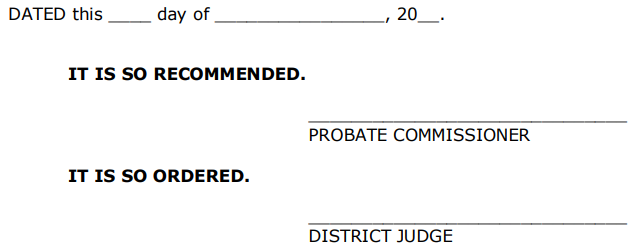
Each proposed Order should include a signature block in the following form:
If real property is being transferred in the order, the legal description, assessor’s parcel number (APN) and street address must be included in the proposed order. Likewise, if a mobile home, trailer or vehicle is being transferred, the order must contain the serial number or vehicle identification number (VIN). It is important to double-check these numbers before submitting a proposed order to avoid the need to later seek an amended order.
The Probate Department will conduct a review of the cases and designate a status on the Calendar found on the Probate Department website by Friday, twelve days prior to your hearing date. All deficiencies will be posted in the Deficiency Report. In some cases, a petition may be denied prior to a scheduled hearing if it is deficient in a way that cannot be cured. Deficient matters are typically re-reviewed for curing documents on the Friday and Monday preceding the hearing date, so matters that are designated as “deficient” may not be re-designated until that time.
Once posted, a deficiency that does not cause your hearing to be vacated can only be cured by filing the curing documents by 12:00 noon on the Monday before your hearing. If deficiencies are not cured by noon on the Monday prior to your hearing date, the matter scheduled for hearing may remain on the “deficient” calendar, and the petitioner or counsel should plan to appear at the hearing to notify the Court that the deficiency has been cured. Even if you timely file a curing document, your attendance at the hearing is required unless the matter is re-designated as a “1” (approved”) on the Probate calendar. If you have questions, if you have cured a deficiency, or you believe your matter was designated in error, please contact probatedept@washoecourts.us.
In cases where proof of publication is not available when the Court reviews your petition, your matter may be designated “deficient” until you file a proof of publication. The matter may be “approved” without a proof of publication, however, if you file an “Interim Publication Report” (IPR) using docket code “3835,” including extra text identifying the document as the Interim Publication Report. The IPR must include a copy of at least one publication email from the newspaper that shows the content of the publication and the dates it will be published. Even if you file an IPR, you must file a complete “proof of publication” no later than Monday at noon before your hearing date.
Objections should be in writing and filed in advance of a scheduled hearing whenever possible. If a party appears in Court to object to any matter, the matter will be continued, depending on the nature of the objection, to allow the objector to file and serve an objection in writing. The Probate Department will notify counsel for the petitioner of the objection and continuance if the petitioner was not present. If no written objection is on file by the continued hearing date or other deadline set by the Court, the original petition may be granted at the continued hearing.
In contested matters where a written objection is filed prior to hearing, the scheduled hearing will become a status hearing where the Court will determine (1) whether a settlement conference should be scheduled; (2) whether an evidentiary hearing or other contested hearing date should be set instead, (3) whether referral to the Probate Judge is necessary or appropriate in the case, and (4) whether discovery or other matters should be addressed by a pre-trial recommendation and order.
In contested matters where a written objection is not filed prior to hearing but an objection is made in Court, the matter will be continued to a future hearing date to permit the filing of a written objection. At the continued hearing, the Court will attempt to determine (1) whether a Settlement Conference should be scheduled; (2) whether a contested hearing date should be set instead, (3) whether referral to the Probate Judge is necessary or appropriate in the case, and (4) whether discovery or other matters should be addressed in a pre-trial recommendation and order.
Settlement conferences must include all adverse parties and their counsel, unless otherwise ordered by the Court. In the case of a settlement conference before the Probate Commissioner, confidential settlement statements must be delivered to the Probate Department by 12:00 p.m. 3 judicial days before a settlement conference. Statements shall be a maximum 5 pages, exclusive of exhibits. Settlement conferences before the Probate Commissioner are usually scheduled for four hours. Settlement conferences before a district judge shall be conducted in accordance with that department’s orders and directives.
When filing a Return of Sale and Petition for Confirmation of Sale of Real Property, the following must be included in the petition or attached as an exhibit, as the case may be:
The Inventory or Record of Value is due 120 days after appointment of the Personal Representative. NRS 144.010 (external link, opens in new tab). The Inventory must contain a description of all assets of the Decedent subject to probate in Nevada and their values as of the date of death, supported by appraisals, when available, or other appropriate third-party evaluations of value. Known encumbrances must also be listed. The Inventory must also identify the property’s character, i.e. community or separate. NRS 144.040(3)(a) (external link, opens in new tab). Each section (real property, personal property, cash assets, etc.) must be subtotaled and show a final recapitulation of all assets, less encumbrances and a total net estate value at the end.
While there is no required form for a probate accounting, it should clearly demonstrate the starting balance for the accounting period (as provided in the Inventory or a previously approved accounting), all receipts and disbursements by the Personal Representative during the accounting period, and the balance on hand at the end of the accounting period. The required form for trust accountings, including the form for a summary of account provided in NRS 165.135(2) (external link, opens in new tab) is acceptable, if accompanied by supporting documentation. Accountings must be detailed and itemized: i.e. show each receipt with the date, payor, description and amount, and show disbursements with the date, payee, description and amount. Subtotal all columns in each section. A recapitulation must be included showing the assets remaining on hand for distribution. Generally, any list of numbers should include a total sum. All Creditor Claims must be listed in the petition for approval of a final accounting, even if untimely, including the name of the creditor, the date filed, the amount, and the disposition of the claim (approved, paid, compromised and paid, or rejected).
The Court tracks the progress of all Summary and General Administration Estates via the Milestones Tracker. The Milestones for any case can be viewed by at: Milestones. Parties and counsel that do not timely meet the deadlines set by the Milestones Tracker may be subject to hearings and the imposition of sanctions. The Milestones are listed below:
| Milestone | General Administration Default Track | NV Statute or Probate Guidelines | Summary Administration Default Track | NV Statute or Probate Guidelines |
|---|---|---|---|---|
| Petition for Appointment | Case Initiation | n/a | Case Initiation | n/a |
| Notice of Hearing | 30 days from Petition | NRS 136.100, NRS 139.100, NRS 155.010 | 30 days from Petition | NRS 136.100, NRS 139.100, NRS 155.010 |
| Proof of Publication of Notice of Hearing | 21 days from Notice of Hearing | NRS 155.020, NRS 155.080 | 21 days from Notice of Hearing | NRS 145.030 |
| Order Appointing | 75 days from Petition | n/a | 75 days from Petition | n/a |
| Letters Issued/Filed | 10 days from Order Appointing | n/a | 10 days from Order Appointing | n/a |
| Notice to Creditors | 30 days from Order appointing | NRS 155.020(4) | 30 days from Order Appointing | NRS 155.020(4) |
| Proof of Publication of Notice to Creditors | 120 days from Order Appointing | NRS 155.020, NRS 155.080 | 90 days from Order Appointing | NRS 155.020, NRS 155.080 |
| Inventory | 120 days from Issuance of Letters | NRS 144.010 | 120 days from Issuance of Letters | NRS 144.010 |
| Accounting | 180 days from Order Appointing | NRS 150.080 | 180 days from Order Appointing | NRS 150.080 |
| Accounting | 435 days from Order Appointing | NRS 150.105 | 435 days from Order Appointing | NRS 150.105 |
| Report to Court - NRS 143.035 | 180 days from Order Appointing | NRS 143.035 | 180 days from Order Appointing | NRS 143.035 |
| Petition for Final Distribution | 435 days from Order Appointing | NRS 150.110, NRS 151.080 | 435 days from Order Appointing | NRS 150.110, NRS 151.080 |
| Petition for Discharge | 510 days from Order Appointing | NRS 151.230 | 510 days from Order Appointing | NRS 151.230 |
Every attorney for a Personal Representative is entitled to a reasonable fee, NRS 150.060(1) (external link, opens in new tab), and only a reasonable fee, cf. RPC 1.5(a) (external link, opens in new tab). An attorney may also seek fees for services provided by a paralegal, NRS 150.060(3) (external link, opens in new tab). Each petition for attorney’s fees is reviewed for reasonableness on a case-by-case basis. There is no “per se reasonable” or “per se unreasonable” amount or percentage of attorney’s fees in probate cases. However, the Court applies particular scrutiny where an attorney’s invoice far exceeds the statutory fees set forth in NRS 150.060(4) (external link, opens in new tab). Attorneys (and paralegals) should not bill for clerical tasks, such as scheduling probate hearings with the Probate Department, lodging a will, e-filing a document, etc.
Fee requests must be supported by a detailed and itemized billing: i.e. the date of service, a description of the service, the time charged, and the hourly rate. Costs must be itemized and all categories (fees and costs) individually totaled. Any cost retainers received must be shown and accounted for in the final request for approval. If relying on a statutory percentage retainer agreement, the agreement must be produced to the Court for examination, and the calculation of fees must be set forth in the petition. This paragraph is applicable to any type of fee request, including one in a set-aside proceeding. Please review the notice requirements for attorney’s fee petitions in NRS 150.060 (external link, opens in new tab).
Unusually high invoices usually involve extraordinary services. Where “extraordinary” fees are sought, the petition (and proposed order) should specifically set forth the extraordinary services performed, and shall set forth the amount of fees for extraordinary services being sought, and the amount of fees for ordinary services. See NRS 150.061 (external link, opens in new tab).
Petitions for Discharge under NRS 151.230 (external link, opens in new tab) must be filed as a separate document following final distribution of the estate (and not as part of the petition for final distribution). A Petition for Discharge may be filed ex parte, along with a Request for Submission and a proposed order; a hearing is not required.
Receipts or vouchers must be filed for all persons or entities receiving money or property, including attorney and Personal Representatives. It is not sufficient for the receipt to state that the devisee or distributee has received, for example, “1/2 of the residue of the Estate”. Each Receipt must indicate the dollar amount or description of the property received to ensure that the entire Estate has been distributed in accordance with the final order.
When an attorney seeks additional fees from the Court for closing the Estate (in the Petition for Distribution), the proposed order should be phrased “…is awarded an additional amount not to exceed $_____”. These fees must be accounted for in the Petition for Discharge (i.e., how much in actual fees were collected between the order for final distribution and the petition for discharge). The Court will not approve more than four hours’ time for closing an estate except by a separate supplemental petition. When an attorney receives payment of some or all of the post-closing fees awarded, the Receipt should so indicate the amount actually paid.
In accordance with to NRS Chapter 140 (external link, opens in new tab), the Court may appoint a special administrator under certain circumstances. The Probate Department urges you to refer to the applicable statutes for details, and that the following procedure be followed:
Your verified petition may be filed ex parte, along with a Request for Submission and a proposed order.
The petition must include a copy of the death certificate (with the social security number redacted) or some other evidence of death. Color copies of death certificates are preferred, in order to avoid the “copy” watermark showing prominently.
The petition must contain allegations which comply with all other statutes pertaining to appointment of Personal Representatives, such as:
The Proposed Order Appointing Special Administrator must contain, in addition to appropriate findings of fact and the appointment language, the following paragraphs:
[IT IS FURTHER ORDERED] that any money received by the estate of the Decedent shall be placed in a blocked estate account, or the attorney’s client trust account, until further order of the Court approving disposition of the funds.
The Special Administrator is shall comply with the provisions of NRS 140.080(2) before selling any securities of the estate.
The Special Administrator is further ordered to comply with the provisions of NRS 144.010 within sixty (60) days from the date of this Order.
The Special Administrator shall petition the Court for administration, setaside, discharge of the special administrator, or a report as to why no such petition can be filed, as appropriate, within one hundred eighty (180) days of the date of this Order.
Sometimes, petitioners seek special administration in order to market a property for sale. A Special Administrator, on request, may be permitted to market a property for sale, and to seek confirmation of a sale, so long as a petition for regular letters is filed concurrently with the petition for confirmation of sale, so that the petitioner is appointed at or prior to the actual closing date. Closing of sales by special administrators is disfavored, and requires express authorizing language in the order confirming sale.
In addition to the above, the Proposed Order Appointing Special Administrator must contain, in cases where the purpose of the appointment is to pursue a wrongful death or other civil action, the following language:
IT IS FURTHER ORDERED that the settlement of any claims or lawsuits on behalf of the estate of the Decedent is subject to the Probate Court’s approval.
Questions? Email us at probatedept@washoecourts.us or call us at (775) 328-3100
Probate
Second Judicial District Court
75 Court Street, Room 125
Reno, NV 89501
(775) 328-3100
ProbateDept@washoecourts.us
Schedule a hearing with the court using the request form found here.
Hearing RequestNeed to find important deadlines in your case? Use the link below to search for them.
Milestone Tracker
Commissioner Gorman’s Biography
Commissioner Gorman’s Courtroom Calendar